One of the most important skills I have found I possess is my ability to observe and pay attention. I am mostly so enrapt at the bounty of what I see, hear, and listen to that I would love to be rich enough to dedicate my life to the art of being a flâneur. A term employed most famously today by Nassim Nicolas Taleb – who strolled his way to authoring a couple tremendously important books – The Black Swan: The Impact of the Highly Improbable and Antifragile: Things That Gain from Disorder.
If you are not familiar with NNT (as I like to call him) he could easily be described as the philosopher's Malcolm Gladwell. Both books are richly dense and full of prose poetry and wide-ranging insights across almost all bodies of knowledge. The first is quite easy to summarize - we believe there are only white swans for quite some time, until our experience is such that we see a black swan – then our entire belief structure around what is possible must come into question. I find it utterly frustrating that so many arguments on the internet are deemed settled by the absence of a LINK to a supposedly definitive study. Really? These people will disbelieve their own experiences simply because someone has not provided funding to explore in a very controlled and often microscopic way a certain topic. That is a fragile intelligence. The improbable happens all the time – studies might show it is a daily occurrence.
Wind extinguishes a candle and energizes fire.
NNT - Antifragile
What Taleb takes us through in exhaustive detail is the truth that our scheming and dreaming minds convince us that we know a lot about reality and what will occur, when the truth is that we do not. And that by fooling ourselves into complacency that our science is near complete we are not truly being at one with the majestic complexity of life as available to us in this universe we have at our disposal for such a short time.
Cultivating Antifragility is the antidote.
Likewise with randomness, uncertainty, chaos; you want to use them, not hide from them. You want to be the fire and wish for the wind. This summarizes this author's nonmeek attitude to randomness and uncertainty.
NNT - Antifragile
I am trying to be at one with the wind in my life and today I failed miserably. It's been challenging for months. I am out of money and craving really meaningful work and my overwhelmed mind is shutting down on a very regular basis. I feel as though I have been open and observant for years and for some reason, the improbable continues occurring. I am unable to earn money.
Life is more, a lot more, labyrinthine than shown in our memory – our minds are in the business of turning history into something smooth and linear, which makes us underestimate randomness.
NNT - Antifragile
Which turns me to the book I just happened to retrieve from storage this weekend, so that it sat on my desk as I read Gert Scholtz' recent tribute to DonQuixote.
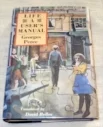
The book is Life: A User's Manual (titled La Vie, mode d'emploi in its original French) by Georges Perec. I read this book very close to 30 years ago and I can think of few that have impacted me so profoundly. Within this book are stories of life. The framework is that the 500 pages take us through the lives of the inhabitants of a hôtel particulier – a mansion turned into 20 to 30 separate apartments. As with so much in life, an accurate count is quite difficult as it changes over time as floors are subdivided and then consolidated based on the fortunes of the occupants. The central story of the book in many ways is the tale of BartleBooth. A rich man who does not need to work, and who decided to occupy his time on his own terms.
In other words, Bartlebooth resolved one day that his whole life would be organised around a single project, an arbitrarily constrained programme with no purpose outside its own completion.
Perec
He decided to take 10 years to learn to paint watercolors. 20 years to travel the world painting a seascape each fortnight which he would send to a craftsman who would apply the watercolor to a backing and cut it into a puzzle. And then he would return to France and spend 20 years reassembling each seascape puzzle in order over a fortnight. Once reassembled, he would send the watercolor back to its port of origin and have it dipped in a solution that would strip the paint and leave a blank piece of paper.
Thus no trace would remain of an operation which would have been, throughout a period of fifty years, the sole motivation and unique activity of its author.
Perec
What strikes me as improbable, very fragile, and profoundly uncomfortable is that most of us embark on a similar programme of non-historical purposes, only without the means of wealth, we would just call it a career.
I am looking for a personal quest to finish out my days and it feels so close and yet so far. Does anyone else have a similar quixotic yearning?
Life is improbable yet full of antifragility – why not be quixotic?
Deb Helfrich